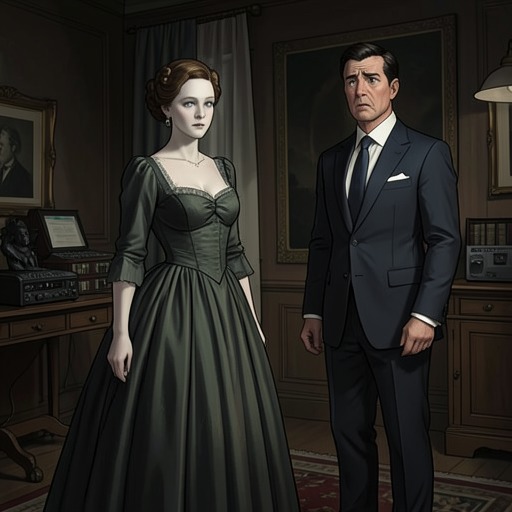
Agnès and Vincent Dantier’s captivity
Impure BloodAgnès and Vincent Dantier’s captivity turns a search for survival into a contest over time: held without food or water, the father and daughter must conserve their strength while trying to remain mentally prepared for captors who may never give them a chance to bargain. Agnès works to sustain Vincent’s resolve even as the threat shifts from waiting and deprivation to direct violence and lethal danger. Their rescue comes only when Paul Darac smashes through the lockup, entering a scene where freeing them and surviving the attackers are inseparable tasks.
Conditions of Captivity
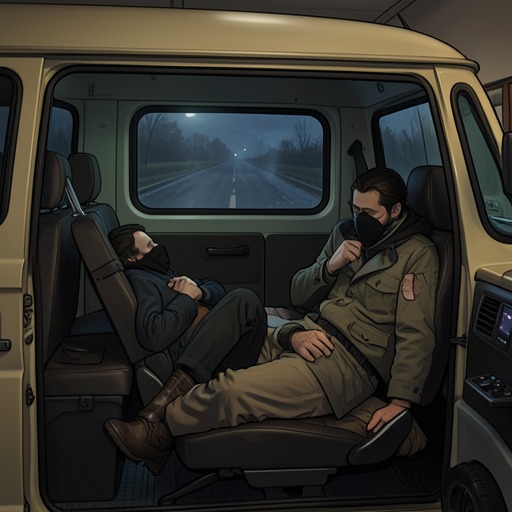
The Dantiers have received no food or water since their incarceration began. They are confined in a van near Gare Thiers, where the trains pass so close overhead that their thunder helps establish the location. Their surroundings also leave them with their own waste, an indignity that becomes part of the captors’ control over their circumstances. The deprivation is not merely physical: it gradually narrows the prisoners’ choices to conserving energy, enduring the next minute, and trying to infer what their captors intend.
Their confinement offers no assurance that a confrontation will come. Vincent voices the fear that even identifying the people responsible would be useless: they cannot radio the information to the police, and knowing who has imprisoned them would not necessarily help when the captors arrive to kill them. His despair makes the uncertainty itself a form of pressure. The possibility that the captors might leave them to lose consciousness and die without ever showing themselves is more frightening to Agnès than a brief confrontation, because confrontation might at least permit negotiation.
Agnès’s Effort to Endure
Agnès responds to the uncertainty by giving herself and her father tasks. She has compiled a list of possible suspects with Vincent partly to keep their minds active and oriented toward something positive. Choosing the most likely candidates serves a second purpose: if the captors appear, she wants specific arguments, appeals, and promises ready. She hopes that even a few seconds of delay could give Paul Darac and his team time to reach them. Her planning is therefore both a practical attempt to bargain and a way of resisting the mental collapse that confinement encourages.
When Vincent begins to come apart, Agnès apologizes for the situation and tells him she will try to stall the captors if they arrive before Darac. Her resolve is not effortless. After hours without speaking to conserve energy, she begins to wonder whether it would be better to give in and stop resisting. She is angry with herself for entertaining that possibility and recommits herself to continuing. The change reveals how survival in the van depends not on a steady confidence but on repeatedly recovering the will to endure.
That effort is tested when the rear door opens without warning. A silhouette appears in the light, and Vincent cries out; the intruder silences him with a movement of a torch. The woman says that the smell is unpleasant but that it will not be long now, then closes the door again. The brief appearance supplies no rescue or explanation. Instead, it confirms the captors’ control over when the prisoners are seen and heard, while renewing Agnès’s expectation that a decisive encounter may be close.
The Captors’ Escalation
A later opening brings two figures into the van: Corinne Delage and a taller, slimmer companion. Vincent mistakes their arrival for salvation and asks for water. Delage refuses, distinguishing water for washing from water to drink. The encounter overturns his hope at the moment he expresses it. Agnès, who had just urged her father to think about Delage as a possible culprit, now sees the woman herself among those controlling their captivity.
The companion is identified as Jarret. He leaves the van after announcing that the prisoners should enjoy what is coming, and a jet of water is then directed at Agnès while she remains restrained. The attack leaves her unable to breathe normally and exhausted; Vincent watches without being able to help. The violence is not an attempt to secure information or an opportunity to escape, but a further demonstration that the captors can inflict suffering while denying the prisoners even the most basic aid. Delage takes the nozzle after Jarret hands it to her, sharing in the assault.
The threat then changes from abuse to an attempt to kill them with vehicle exhaust. A small circular panel in the roof disappears, and a flexible hose is pushed through the opening. The van’s engine starts and fumes begin to enter the enclosed space. Vincent turns to Agnès, understanding that he may be seeing his daughter for the last time. By this point, the prisoners’ confinement has become an immediate lethal emergency rather than a matter of waiting to discover their captors’ intentions.
Darac’s Breach and the Rescue Attempt
Paul Darac reaches the lockup and drives his Peugeot through the roller door, using the shattered entrance to get inside quickly. He sees the hose running from the van’s tailpipe and acts without pausing to prepare. As bullets are fired from the cab, he removes the hose and opens the van’s rear doors, releasing the fumes. The intervention interrupts the attempt to asphyxiate the prisoners, but it also exposes Darac to gunfire and forces him to divide his attention between the captors and the people inside.
Darac uses a fallen door section as a shield before moving toward the tailpipe. Once he has opened the van, he takes cover behind a tool cabinet as shots strike around him. A bullet wounds his left forearm, but he continues firing and identifies Jarret as the shooter in the cab. The rescue is thus not a clean transition from danger to safety: the prisoners remain amid fumes and crossfire, while Darac must stop the attack before he can tend to them.
When Delage says the prisoners are already dead, Darac recognizes an opening. He lunges at her, knocks the gun from her grasp, and secures the weapon, making it possible for the rescue to proceed. He then enters the van and goes directly to Agnès. Her head has been shaved, and she is barely breathing; her pulse is weak and irregular. Darac calls the medical teams and begins the urgent work of getting her free and into fresh air. Her restraints complicate even basic emergency care: he considers mouth-to-mouth resuscitation if she stops breathing, but recognizes that CPR may not be possible while her shackles prevent him from laying her on her back.
Significance of the Captivity
The captivity’s progression is marked by a sequence of reversals: the prisoners wait for a confrontation that might give them leverage, a captor’s brief appearance offers no help, and the arrival of Delage and Jarret turns the hope of rescue into further danger. Agnès’s efforts to reason, plan, and encourage Vincent preserve a limited form of agency, but they cannot overcome the physical power the captors hold over the confined pair. Their survival finally depends on intervention from outside the van, and even that intervention begins under fire.
The contrast between Agnès’s careful preparation and the captors’ unpredictable violence gives the ordeal its central tension. She tries to make a future encounter intelligible by anticipating suspects and choosing words that might delay an attack; the captors instead control when to appear, what necessities to deny, and when to escalate. Darac’s breach breaks that control only partially: the exhaust hose is removed and Delage’s weapon secured, but Agnès’s condition remains precarious and medical help is still required. The captivity therefore ends not with an instant restoration of safety but with a rescue effort whose first task is to keep its victims alive.